
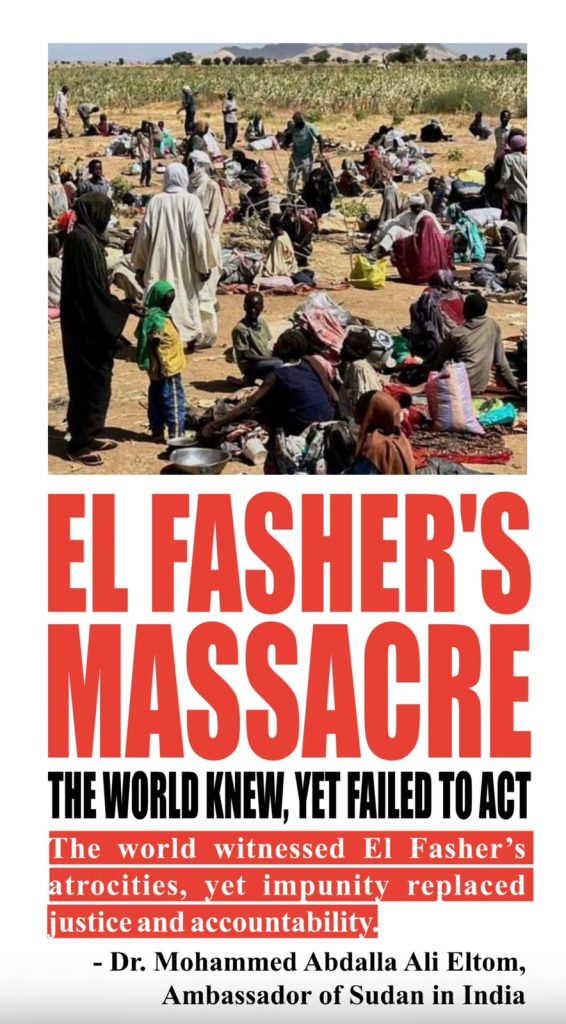
New Delhi, (Nabaa Sudan) – The Indian magazine “World Affairs – The Journal of International Issues” published, in its 16 November issue, an article by Dr. Mohamed Abdalla Ali Al-Tom, Ambassador of the Republic of Sudan to the Republic of India, entitled “El-Fasher’s Massacre: The World Knew, Yet Failed to Act.”
The article examined the dimensions of the massacre committed by the Rapid Support Forces (RSF) militia in the city of El-Fasher in October 2025, highlighting the scale of violations and atrocities inflicted on civilians, the prolonged siege and repeated international warnings that preceded it, and the international community’s failure to take effective measures to prevent the catastrophe, despite the availability of information, warnings and the necessary international mechanisms for action.
In his article, the Ambassador Al-Tom reviewed the findings documented by United Nations institutions regarding mass killings, field executions, sexual violence, and attacks on civilians and health facilities. He cited statements by UN High Commissioner for Human Rights Volker Türk, who stressed that the atrocities witnessed in El-Fasher had been anticipated and could have been prevented, but were not.
The article also addressed the regional and international dimensions of the war in Sudan, warning of the consequences of continued external military, financial and logistical support for the Rapid Support Forces (RSF) militia. It called for those involved in arming and financing the militia and facilitating the supply of mercenaries to it to be held accountable under international law, considering this an essential condition for any serious effort to end the war and achieve peace.
In this context, the article highlighted the important role India could play, as one of the influential countries of the Global South, in supporting the work of multilateral international institutions, strengthening the effectiveness of the international system, and promoting an international response based on the principles of justice and the non-selective application of international law.
The Ambassador Al-Tom also addressed the peace initiative presented by the Sudanese government to the UN Security Council and submitted by Prime Minister Dr. Kamil Idris. He explained that the initiative is based on a ceasefire under international and regional monitoring; the withdrawal and disarmament of the Rapid Support Forces militia; ensuring unhindered humanitarian access; delivering justice for victims; and launching an inclusive, Sudanese-led political process leading to free elections. He affirmed the government’s openness to constructive international initiatives, provided they are consistent with the principles and fundamental pillars of the Sudanese initiative.
The article stressed that the passage of one year since the fall of El-Fasher represents a genuine test of the credibility of the international community and its institutions. History will hold accountable not only the perpetrators of the crimes, but also those who possessed the political influence and institutional capacity to prevent them but failed to fulfil their responsibilities.
The article concluded with a question posed by Tom Fletcher, the UN humanitarian chief, before the Security Council: “Can anyone here say that we did not know this was going to happen?”
It is worth noting that “World Affairs – The Journal of International Issues” is an Indian periodical specialising in international relations and global political and economic affairs. It publishes studies and analyses on geopolitical, economic and diplomatic issues, international security, as well as development, technology and culture, with particular attention to the perspectives of India, Asia and developing countries on international developments and issues. The journal also seeks to promote dialogue and interaction between developed and developing countries.
The magazine targets a broad readership, including decision-makers, diplomats, researchers, academics, research centres, universities and government institutions. It also features contributions from a number of political and intellectual figures and researchers from various countries around the world.
The publication of the article comes as part of Sudan’s diplomatic and media presence in Indian intellectual and media circles, highlighting the Sudanese perspective on developments in the war of aggression against Sudan and its regional and international repercussions, and calling for a more effective international position on the violations suffered by the Sudanese people.
#Sudan#Nabaa_Sudan#Nabaa