
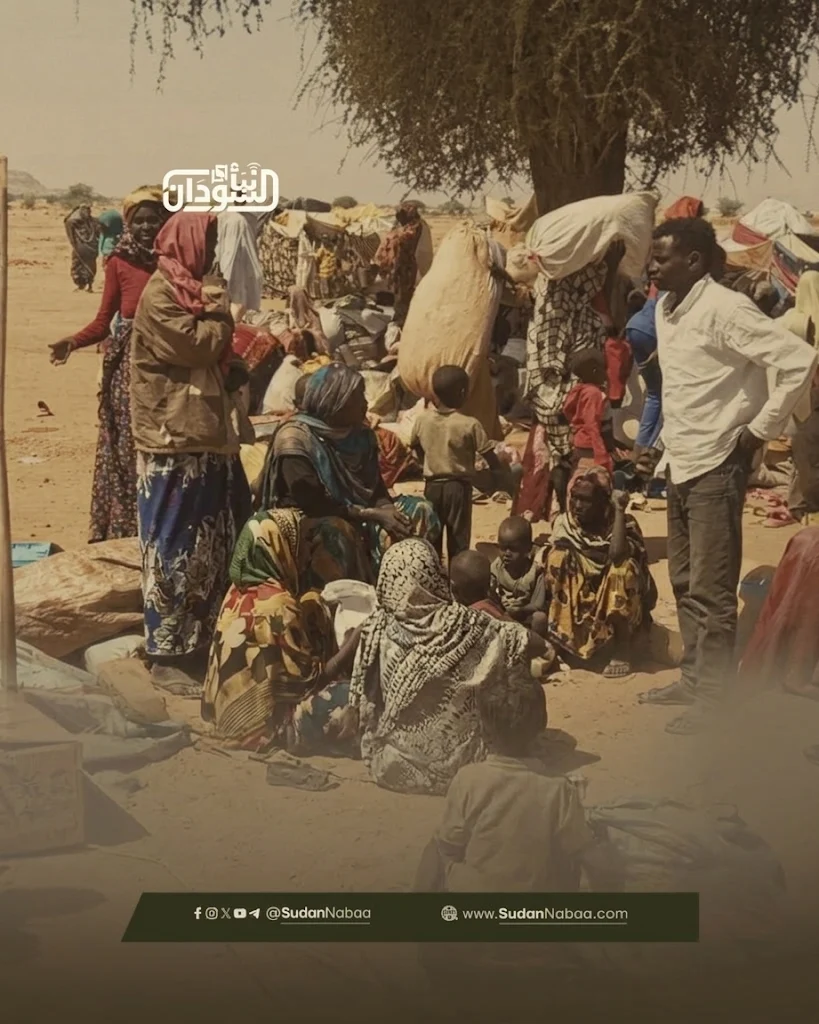
Nabaa Sudan – The United Nations’ International Organization for Migration (IOM) has revealed a widening scope of humanitarian needs in Sudan, noting that 68% of households face livelihood gaps, amid growing needs related to water, sanitation, education, health and protection.
According to the organization’s Multi-Sectoral Needs Assessment (MSNA) report, 68% of households identified livelihoods as their greatest unmet need, while 59% reported unmet needs in water, sanitation and hygiene (WASH), and 30% faced difficulties accessing water.
The report indicated that 38% of households had unmet shelter needs and 37% had unmet protection needs, while 38% of households requiring healthcare were unable to access it.
The assessment was based on interviews with 23,736 households across 185 localities in all Sudanese states, conducted between July 23 and August 17, 2026. It aimed to determine the scale and severity of humanitarian needs and provide data to support response planning for the coming year.
The report noted that Sudan’s humanitarian crisis is no longer confined to a single sector, but is increasingly characterized by overlapping economic, food, health and education needs, alongside deteriorating infrastructure and declining livelihood opportunities.
In the education sector, the report found that needs affected 42% of households, while 45% of children aged 5 to 18 were not regularly attending formal education during the 2025–2026 academic year. School enrolment stood at 29% among internally displaced persons (IDPs), compared with 59% among non-displaced people and 54% among returnees.
West Kordofan recorded the lowest school attendance rate at 10%, followed by North Darfur at 16%, Central Darfur at 25% and South Darfur at 27%. The report attributed disruptions to school closures caused by the war, teacher shortages, the use of schools as shelters for displaced people, and damage to classrooms and their deteriorating conditions.
Education costs, including fees, school uniforms and transportation, were cited as barriers by 27% of non-displaced households, 25% of displaced households and 36% of returnee households. Meanwhile, 14% of children from non-displaced households were engaged in income-generating activities instead of attending school, compared with 4% among displaced households and 2% among returnees.
The assessment highlighted that the highest levels of unmet needs were concentrated in Darfur states and parts of Kordofan, where households face simultaneous shortages of food, income, water and sanitation, education, healthcare and protection.
North Darfur recorded the highest levels of unmet needs in several sectors, reaching 88% for livelihoods, 79% for protection, 75% for sanitation, 72% for education, 51% for food security and 49% for health. In East Darfur, unmet livelihood needs reached 92%, while water and health needs stood at 62% and 47%, respectively.
According to the report, internally displaced persons face higher levels of unmet needs than non-displaced communities. Unmet water, sanitation and hygiene needs stood at 79% among IDPs, compared with 56% among non-displaced households, while livelihood needs reached 83% and 66%, respectively.
Food security needs affected 45% of displaced households, compared with 25% of non-displaced households, while protection needs stood at 60% and 33%, respectively.
The report stated that 98% of households complained about rising prices of basic commodities in local markets during the month preceding the assessment, including food and fuel, while 97% reported increases in food prices.
It also indicated that 68% of households relied on coping strategies to deal with deteriorating livelihoods, while 46% depended on daily or temporary labour as their main source of income, followed by private businesses and agricultural production at 15% each.
Dependence on daily labour was highest in Khartoum at 66%, followed by South Darfur at 55% and West Darfur at 53%. The rate stood at 54% among displaced households, compared with 44% among non-displaced households.
Regarding food security, the data showed that 69% of households had acceptable food consumption levels, while 23% recorded borderline consumption and 8% poor consumption. Several localities in North Darfur recorded particularly high levels of poor and borderline food consumption, reaching 100% in Al-La'it, Al-Tuwaisha and Om Kaddada, and 99% in Kabkabiya.
In the health sector, the report stated that 38% of households requiring healthcare were unable to obtain it due to the inability to afford treatment, the unavailability of services or the absence of a nearby health facility.
Only 31% of households could reach the nearest functioning health facility within a 15-minute walk, while 31% needed between 16 and 30 minutes, 18% between 31 and 60 minutes, and 13% more than an hour.
West Kordofan recorded the highest proportion of households requiring more than an hour to reach health facilities, with the figure exceeding 50% in Al-Mairam locality. Regarding maternal health, the assessment found that 44% of the most recent births reported by households took place at home, compared with 38% in government health facilities.
In the water sector, 86% of households reported using improved drinking water sources. However, 49% said they had faced varying degrees of difficulty meeting their water needs during the four weeks preceding the assessment. The proportion rose to 68% among displaced households, compared with 46% among non-displaced households and returnees.
Furthermore, 30% of households reported difficulties accessing justice, legal services or official documentation due to security risks and threats, while 33% faced difficulties accessing services such as healthcare, education and government services.
The assessment also found that 61% of households reported that at least one woman or girl in their family had avoided certain areas due to security concerns during the three months preceding the assessment. These included roads used for collecting firewood, markets, checkpoints, public transportation and water collection points.
#Sudan#Nabaa_Sudan#Nabaa