
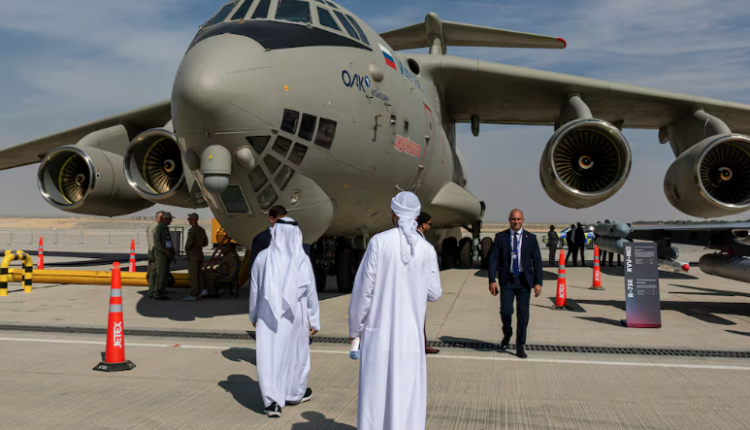
An investigative report by Defense News has revealed that the United Arab Emirates (UAE) has regularly relied on the Russian cargo airline Aviacon Zitotrans, which is subject to US and Western sanctions, in connection with military and paramilitary operations in Africa.
The investigation drew on an analysis of thousands of flight records, gigabytes of leaked internal documents and email correspondence. These materials showed that Russian cargo aircraft had been linked to more than 100 missions carried out on behalf of the UAE government and ruling family since mid-2025. Aviacon Zitotrans is under sanctions imposed by the United States, Canada and Ukraine over its support for Russia’s war effort and its previous role in supporting Moscow-backed mercenaries in Africa.
Sudan at the Centre of the Contradictions
According to the investigation, Sudan is the clearest example of the contradictions and complexities surrounding these operations.
Support for opposing sides: The investigation indicates that the UAE and Russia have become deeply involved in Sudan’s civil war, but support opposing sides. While Abu Dhabi backs the Rapid Support Forces (RSF) militia, Russia has thrown its weight behind the Sudanese government and the Sudanese Armed Forces (SAF).
The paradox of shared aircraft: The UAE’s reliance on the Russian airline has created a striking paradox: the same Russian cargo aircraft may have been supplying both sides of the same conflict. At times, the aircraft fly from Russia and Türkiye to Port Sudan, the Sudanese Armed Forces’ main supply hub. On other occasions, they undertake UAE missions believed to support the RSF through routes across the African interior.
Suspicious flight routes: Flight tracking data for the Russian company’s Ilyushin Il-76 aircraft showed them travelling from the UAE towards Africa, following routes and operational patterns similar to those used by other entities previously linked to the transport of Emirati support to the RSF in Sudan.
Other Operational Details Revealed by the Investigation
Concealing aircraft identities and changing routes: The aircraft typically took off from UAE airports, including Al Ain International Airport and Suweihan military air base, before heading south and west towards the Gulf of Aden. Pilots deliberately switched off their transponders to conceal their actual destinations in Africa. The aircraft then returned to the UAE several days later.
Stops in Africa and Pakistan: The investigation tracked aircraft landing in Ethiopia, including at Harar Meda Air Base and Addis Ababa Airport, and in Somalia, at Bosaso, on missions for the UAE. Other flights were traced from the UAE to a private, secretive airstrip in eastern Pakistan linked to the ruling family’s private houbara bustard hunting trips.
Circumventing sanctions on goods: Leaked shipping documents revealed that the UAE had become a hub for Russia’s circumvention of Western sanctions. Invoices showed that Western electronic goods subject to sanctions were purchased and shipped to Russia through the UAE.
Sudan#Nabaa_Sudan#Nabaa