
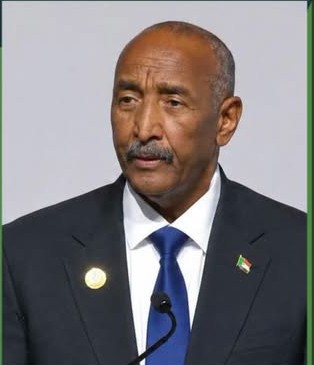
Antalya (Nabaa Sudan) – President of the Transitional Sovereignty Council (TSC) General Abdel-Fattah Al-Burhan affirmed Sudan’s commitment to and support for the common positions and principles expressed by the African Group, the Arab Group, the Group of 77 and China, and the Least Developed Countries (LDCs).
Addressing the 31st Conference of the Parties (COP31) on climate change in the Turkish city of Antalya on Wednesday, Al-Burhan stressed the importance of continuing to work in a spirit of cooperation, solidarity and equity, while respecting the principle of common but differentiated responsibilities and respective capabilities, taking into account the national circumstances and priorities of developing countries, particularly the least developed countries and those affected by conflicts and crises.
The conference, organized by the United Nations, is attended by a wide range of heads of state and government, UN Secretary-General António Guterres and Turkish President Recep Tayyip Erdoğan.
The TSC President added that Sudan had submitted its Third National Communication and Biennial Update Report in April 2025, and was currently working on preparing its Fourth National Communication and first Biennial Transparency Report. This, he said, reflected Sudan’s continued commitment to fulfilling its obligations regarding climate transparency and reporting, despite the circumstances and challenges facing state institutions.
”Like many developing and African countries, Sudan has remained among the countries most exposed to the adverse impacts of climate change, while its contribution to global emissions remains limited,” he said. “The effects of climate change have become increasingly evident in our country through rising risks of droughts and floods, desertification and land degradation, water scarcity, declining agricultural and pastoral production, and threats to food security and livelihoods,” he added.
Al-Burhan explained that the exceptional circumstances Sudan had faced since 2023, namely the war waged against its people and resources by the Rapid Support Forces (RSF) militia, which is supported by certain regional countries, had compounded these challenges and affected infrastructure, services, institutions and communities' ability to cope with climate risks.
”Therefore, addressing climate change in Sudan cannot be separated from peace, food and water security, sustainable development and building resilience,” he said.
Al-Burhan stressed that adaptation was not an option for Sudan but an urgent national necessity. He said the country needed to strengthen investment in water resource management, climate-resilient agriculture, pastoral systems, restoration of degraded land, combating desertification, protecting ecosystems, early warning systems and disaster risk management.
”Climate finance must not remain merely a declared commitment or be tied to political considerations. It must be translated into resources that developing countries can access fairly, swiftly, easily and predictably, alongside capacity-building for national institutions, enabling developing countries, particularly the least developed countries and those affected by conflicts and crises, to effectively benefit from climate finance mechanisms. We also call on developed countries to scale up funding for adaptation,” he said.
The TSC President noted that Sudan possessed significant potential in renewable energy, particularly solar power, land management, sustainable agriculture, ecosystem restoration and water management.
He called on international partners to work with Sudan to transform its potential, resources and plans into tangible investments, scalable projects, job opportunities and greater resilience.
”Let us make climate action a tool for strengthening peace, development, food and water security, and stability, and for building a safer and more equitable future for generations to come,” he concluded.
#Sudan#Nabaa_Sudan#Nabaa