
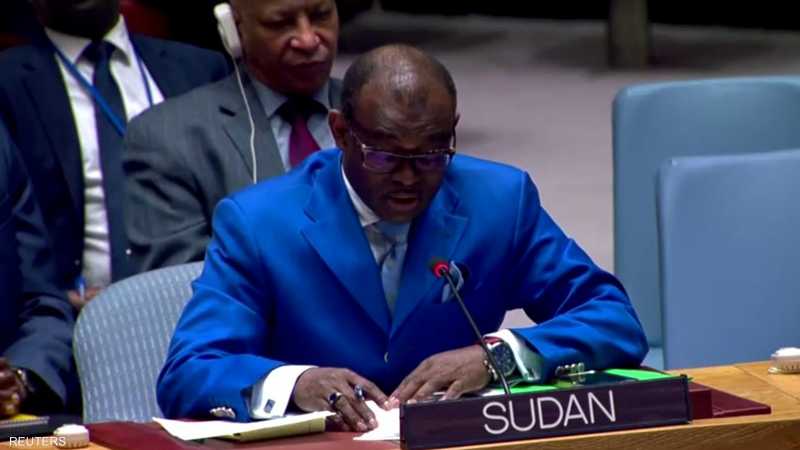
New York, (Nabaa Sudan) – Sudan’s Permanent Representative to the United Nations, Ambassador Al-Harith Idris, delivered strong responses to statements by the representatives of the United Arab Emirates (UAE) and Chad before the 81st session of the United Nations General Assembly.
Al-Harith strongly objected to the UAE representative’s description of the authorities in Sudan as the “Port Sudan government,” saying, “It is a description unbecoming of this international forum, whose Charter stipulates equality among its members.” He added, “We could describe the UAE as the Abu Dhabi regime or use even worse and insulting descriptions and say that the regime belongs to a family; but ultimately, we act according to our morals and values,” adding, “Every vessel gives out what it contains.”
He explained that the worsening humanitarian catastrophe in Sudan, which the UAE representative had referred to, was partly caused and exacerbated by the UAE through its support for the terrorist rebel Rapid Support Forces (RSF) militia, noting that this support has been documented in reports by the Panel of Experts concerning Resolution 1591, as well as in the report of the Fact-Finding Mission, which documented the continuous supply.
The Sudanese UN Envoy said that its claims of neutrality and innocence would not succeed in covering up its crimes and atrocities, as it is engaged in a bloody partnership with the RSF militia. He added, “Whenever we remain silent about it unwillingly, we are compelled to respond to it.”
Al-Harith listed a series of practices pursued by the UAE to destabilize the region and seek to replace the rules of the international order that should apply to everyone.
He affirmed that its support for the rebel militia is not limited to purchasing weapons, but extends to efforts to dismantle the Sudanese government and destabilize the region by fomenting sectarian strife and hatred, undermining Sudan’s role in various institutions, and seeking to sabotage its relations with its neighbors through media campaigns and artificial intelligence, as well as undermining the dignity of the Sudanese people.
Sudan’s representative accused Abu Dhabi of seeking to establish a parallel administration in Nyala, carrying out ethnic cleansing, and using foreign mercenaries to attack the Armed Forces, in addition to counterfeiting Sudanese currency, smuggling strategic minerals, sabotaging energy, electricity, and water networks, targeting dams and food warehouses, and disseminating misinformation, including allegations about the use of chemical weapons.
In his response to the UAE representative, Al-Harith affirmed that the core of the external support network for the RSF militia is documented in numerous international reports, noting that individuals in companies registered in the UAE contract with these mercenaries and purchase their services to transport military equipment.
In refuting the chemical weapons allegation, Al-Harith strongly responded to the UAE claims, describing them as assertions adopted by the UAE intelligence services and concocted in Abu Dhabi that are not based on any technical or legal standards.
Sudanese UN Representative posed rhetorical questions to the UAE representative: “Did you photograph the crime scene? Did you take soil and water samples? Where are the victims?” He affirmed that Sudan is an active member of the Organisation for the Prohibition of Chemical Weapons (OPCW) and that testing is conducted only through its accredited laboratories, while anything otherwise constitutes political targeting.
Al-Harith revealed security information indicating that RSF members and mercenaries had received intensive and advanced training in the use of drones, artillery, and air defense systems before being deployed to the battlefield inside Sudan.
On the other hand, Sudan’s Ambassador to the United Nations addressed Chad’s representative, calling on him to refer to the recently issued report of the International Independent Fact-Finding Mission, dated September 23, 2026, and titled Fueling the Conflict in Sudan: External Factors. He cited several paragraphs of the report, including paragraphs 47, 54, 72, 80, and 84, among others, which confirm the involvement of external powers, foremost among them the UAE and Chad, in fueling the conflict and facilitating the supply of weapons.
He also accused Chad of opening its borders and territory to serve as a transit route for the delivery of weapons, military equipment, and mercenaries to the terrorist RSF militia.
Sudan#Nabaa_Sudan#Nabaa#