
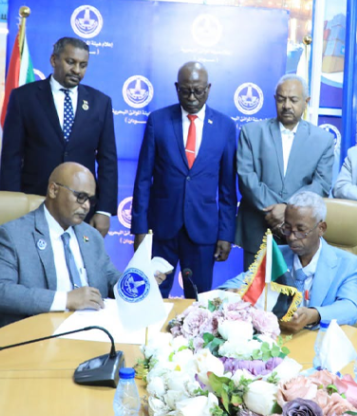
In a strategic move aimed at strengthening economic and national security, Port Sudan witnessed the signing of a historic partnership agreement between the Sea Ports Corporation and the Sudan Shipping Line Company (Sudan Line), in the presence of the Minister of Transport and Infrastructure and the State Minister at the Ministry of Finance.
The agreement seeks to revive Sudan's national shipping fleet and activate the blue economy by reducing dependence on foreign carriers, whose costs surged by 120 per cent following the Strait of Hormuz crisis earlier this year.
Minister of Transport and Infrastructure, Engineer Saif Al-Nasr, described the revival of the national fleet as a cornerstone of Sudan's development and a step toward transforming the country's ports into a gateway to Africa. He said the Ministry is working to rehabilitate productive sectors and close development gaps alongside broader national efforts.
He expressed hope that Sudanese vessels would once again sail international waters carrying the country's name, noting that the acquisition of the first vessel marks the beginning of a broader expansion plan.
State Minister of Finance and Chairman of Sudan Line, Mohamed Nour Abdel Dayim, announced the company's official return to service with the acquisition of the vessel Arkaweet, named after the first ship owned by Sudan in 1962.
He described the development as a victory for the Sudanese people and said the strategic objective is to build a national fleet of 60 vessels. He stressed that a national carrier is not merely a shipping instrument but also a symbol of state sovereignty and an economic necessity for combating inflation and securing supply chains for strategic commodities, including fuel, wheat and medicines.
For his part, Sea Ports Corporation Director Engineer Gailani Mohamed Gailani said the partnership goes beyond protocol arrangements to encompass joint operations, with the Ports Authority providing technical and logistical support while Sudan Line manages commercial activities.
He said the arrangement would reduce maintenance and handling costs by up to 40 per cent and announced that a second container vessel is en route to Port Sudan to serve passenger, petroleum and livestock transport needs.
Sudan Line Director Omar Al-Khalifa described the agreement as a historic step that restores the national carrier's role as a “mobile embassy” for Sudan in global ports and praised the Ministry of Finance for supporting the company's relaunch.
The initiative comes as Sudan seeks to reduce the foreign exchange costs associated with maritime transport and advance three key objectives: breaking foreign dominance in shipping services, lowering import costs and inflationary pressures, and supporting reconstruction efforts by ensuring affordable transport of strategic construction materials such as steel and cement.
#Sudan-Nabaa#Sudan
Follow Nabaa Sudan channel on WhatsApp:
https://whatsapp.com/channel/0029VaG1qJ2FHWpuSTsncX43