
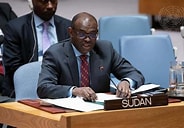
Sudan’s Permanent Representative to the United Nations, Ambassador Al-Harith Idris, has refuted allegations that the Sudanese Armed Forces used chemical weapons, stressing that no evidence has been presented to substantiate such claims, and calling on the UN Security Council to take decisive measures to halt foreign interference and support the peace process in Sudan.
Addressing the Security Council, Idris said that allegations raised by Massad Boulos regarding Sudan’s rejection of his proposals are inaccurate, noting that the Transitional Sovereignty Council (TSC) is following the discussions and has submitted a response that includes an amended withdrawal timetable and steps toward restoring peace.
He said the issue of chemical weapons “should be left to the competent authorities, foremost among them the Organisation for the Prohibition of Chemical Weapons (OPCW),” adding that Sudan is a member of its Executive Council and has formed a national committee to engage with the United States on the matter.
He further stated that a US team visited Sudan and conducted field inspections of sites where the allegations were raised, collecting samples from four locations, yet “no evidence has been presented proving that the Sudanese Armed Forces used chemical weapons.” He added: “No US entity has provided a single piece of evidence supporting these claims.”
On the political process, the envoy stressed the need to resolve inconsistencies among various mediation tracks, criticising the holding of external conferences “from which Sudan is not invited.” He urged the Security Council to support the Jeddah Agreement as the primary foundation for peace efforts, reaffirming the principle of national ownership of the political process.
He called for strict measures to expel foreign mercenaries from Darfur and Kordofan, noting that Sudan has submitted a list of their names to the Security Council, and urging activation of regional and international agreements to combat mercenarism.
Idris also stressed the need to investigate the activities of security companies involved in recruiting and transporting mercenaries, and to hold accountable those implicated, alongside supporting investigations into war crimes and violations.
He concluded by calling for the establishment of a compensation fund for victims, survivors, and affected communities, while obliging armed militias to protect civilians and end violations.
Ambassador Idris further reiterated calls to end foreign interference and immediately stop the systematic attacks by the Rapid Support Forces (RSF) on civilians, including drone strikes, as well as to halt financial, military, weapons, and personnel support provided by the United Arab Emirates and some neighbouring countries to the militia.
He also called for the expulsion of foreign mercenaries from Darfur and Kordofan, saying Sudan has submitted their names to the Security Council, and urged activation of the African Union and international conventions against mercenaryism. He further called for accountability of security companies involved in recruiting and transporting mercenaries, including UAE-based firms, and for international, regional, and national investigations into war crimes and crimes against humanity.