





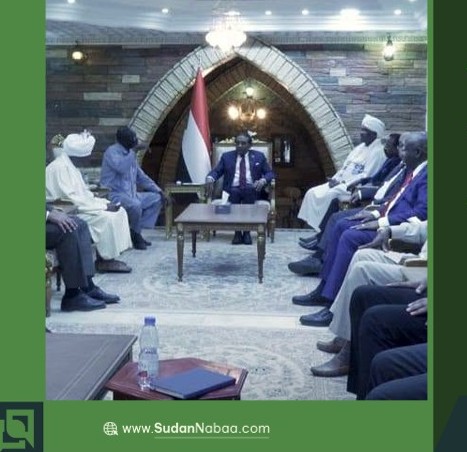
Khartoum (Nabaa Sudan) – Sudan’s Prime Minister Dr. Kamil Idris held an emergency meeting with members of the Government of Hope, attended by ministers, state ministers and a number of undersecretaries, following the conclusion of the Strategic Hope Forum, which was hosted in Khartoum over the past three days and ended on Sunday.
The meeting discussed a number of key issues and files, foremost among them the outlines of an urgent plan to be developed in the coming days to adopt austerity measures and reduce government spending. It also examined economic measures aimed at easing the cost-of-living burden on citizens and improving living conditions.
In this context, the Undersecretary of the Ministry of Trade announced that the ministry had established eight subsidised sales outlets in Khartoum State. He noted that work was under way to launch a project to sell bread at reduced prices, which is expected to begin soon in Khartoum and several other states as part of efforts to ease the cost-of-living burden on citizens.
The meeting also discussed a plan to dispatch an aid convoy to North Kordofan State to support those affected by the war and provide essential supplies to people facing humanitarian hardship.
On foreign relations, the Minister of Foreign Affairs briefed the meeting on Sudan’s participation in the United Nations, the course of Sudanese relations, and matters related to engagement with countries in the region and around the world, in line with the state’s official vision and with a view to safeguarding national sovereignty.
The Minister of Energy also briefed the meeting on the “Light and Water” (Noor wa Ma’a) programme, announced by the government as part of its plan to serve citizens and ensure the delivery of fuel and electricity, support the restoration of essential services and strengthen productive sectors.
The Minister of Agriculture and Irrigation spoke about water services and his ministry’s efforts to provide renewable water stations, expand water connections and connect citizens to water networks. He noted that a further 25% of beneficiaries had gained access to these services in a number of cities and villages.
The minister reaffirmed the ministry’s commitment to expanding access to water through irrigation projects powered by solar energy, helping improve water services, extend their reach in cities and villages, and ensure a sustainable water supply. He also highlighted cooperation between his ministry, the United Nations Children’s Fund (UNICEF) and the Kingdom of Saudi Arabia to support water projects and improve water supply services for citizens.
Meanwhile, the Minister of Culture, Information, Antiquities and Tourism briefed the meeting on his ministry’s plan to resume operations at the remaining institutions damaged by the war and repair destruction caused by militia crimes. The plan forms part of the ministry’s efforts to restore the activities of cultural, media and tourism institutions, rehabilitate damaged facilities and resume their role in serving the community.
The meeting forms part of the government’s efforts to set priorities for the coming phase, with a focus on studying urgent measures to reduce public spending, ease economic pressures on citizens, improve essential services, support those affected by the war, rehabilitate damaged institutions and strengthen foreign relations.
Sudan#Nabaa_Sudan#Nabaa