

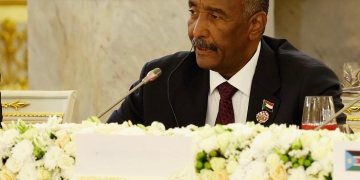




Khartoum (Nabaa Sudan) – General Abdel-Fattah Al-Burhan has arrived in Moscow at the head of a high-level delegation to attend the Third Russia-Africa Summit, held under the theme “For Peace, Security and Development,” with the participation of more than 48 African countries.
The composition of the delegation reveals the nature of the issues on the agenda. It includes the Ministers of Foreign Affairs and Finance, the Director-General of the General Intelligence Service, and the Director-General of the Defence Industries System. A direct bilateral meeting with President Vladimir Putin is also scheduled for today, according to the Russian news agency TASS.
Relations between Khartoum and Moscow are not new. They began after independence during the era of President Ibrahim Abboud, reached their peak under President Jaafar Nimeiry, when 2,000 Soviet advisers were present in Sudan, and later evolved under President Omar Al-Bashir into a partnership without conditions following the US sanctions imposed in 1997. Russia supported Sudan against intervention in Darfur, in return for Sudanese support for Russia’s annexation of Crimea in 2014.
Today, the record of agreements between the two countries includes:
• 2017: The Sochi understanding between Al-Bashir and Putin on the establishment of a naval base.
• 2019: An agreement to establish a logistical support centre, alongside a seven-year security cooperation agreement.
• 2020: A 25-year military agreement.
▪️ Sudan’s potential gains amid the current pressure fall into three categories:
1. Political gains – The veto
Russia was among the first countries to affirm its support for Sudan’s sovereignty and institutions, foremost among them the Armed Forces. In November 2024, it used its veto power to block a draft resolution on the war at the UN Security Council and opposed extending the arms embargo beyond Darfur.
This political cover is Khartoum’s most important card in confronting Western pressure.
2. Military gains – A naval base in exchange for air defence systems
Last February, former Foreign Minister Ali Yousuf Al-Sharif announced in Moscow that “everything” had been agreed upon regarding the naval base.
The agreement provides for a 25-year base lease, renewable for an additional term, with 300 military personnel and four warships, including nuclear-powered vessels, to be stationed in Port Sudan. It also grants Russia priority access to mining concessions.
In return, Khartoum is seeking advanced air defence systems and precision-guided munitions at preferential prices. Experts describe this deal as one that could alter the tactical balance and strengthen Sudan’s defence capabilities.
3. Economic gains – From twinning to grain supplies
Just six days ago, on October 23, a twinning agreement was signed between Port Sudan and Saint Petersburg. It covers the development of ports, roads, airports, mining and agriculture, as well as scholarships for bachelor’s, master’s and doctoral studies.
At the current summit, Russia also offered direct grain supplies to the African continent to address food shortages. This is a vital issue for Sudan, which is facing severe economic pressure from regional and international actors supporting the war.
▪️ Conclusion
Sudan is not travelling to Moscow as a mere protocol guest. It is going there while under military and economic siege. Russia, meanwhile, is presenting itself as a partner without preconditions: selling arms and air defence systems, while seeking a strategic foothold on the Red Sea, through which 12% of global trade passes.
Al-Burhan’s visit is an attempt to turn an intersection of interests and promises dating back seven years into agreements that can be implemented.
#Sudan #NabaaSudan #Nabaa